

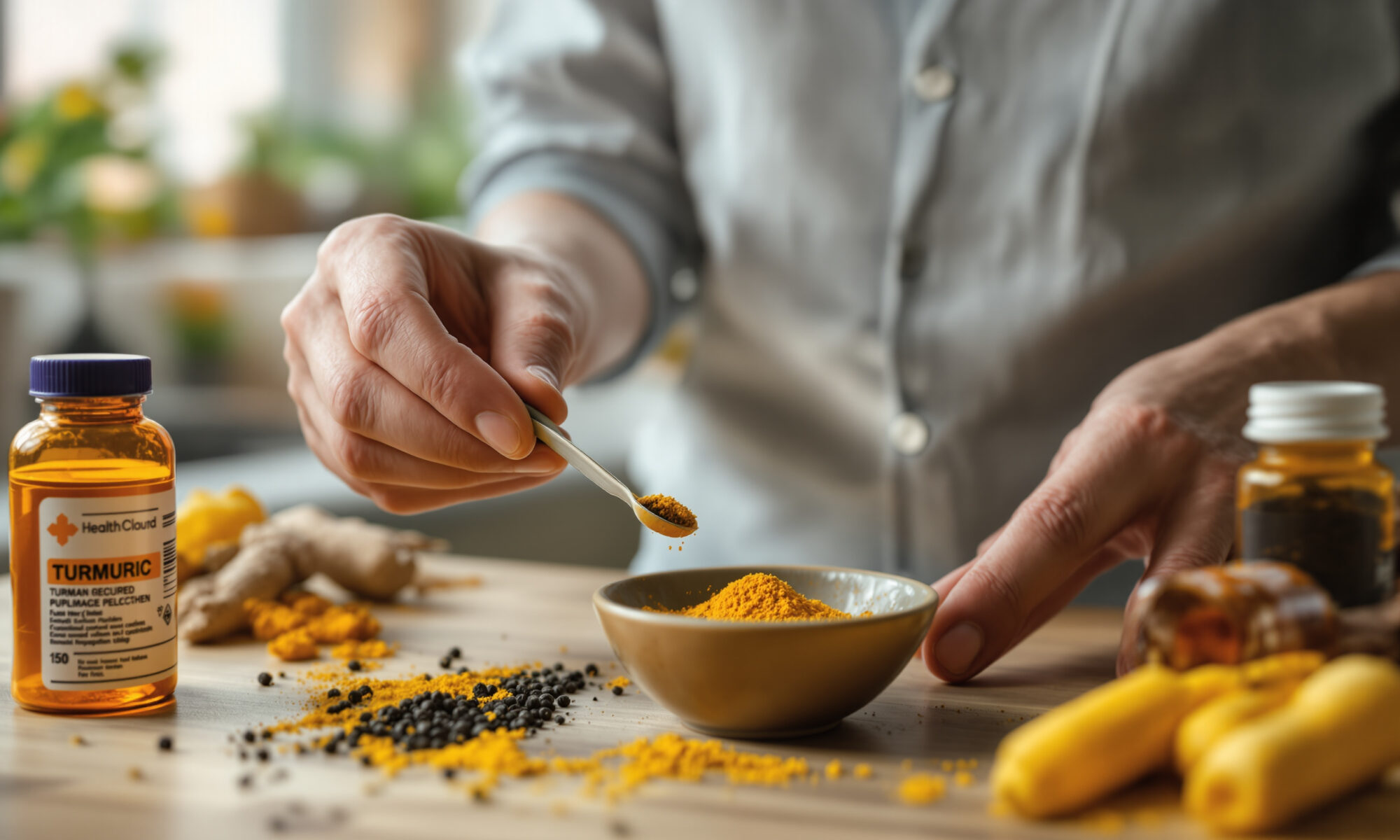
Turmeric curcumin benefits are real in a few narrow areas, especially modest pain relief for knee osteoarthritis, but they’re often marketed far beyond the evidence. Curcumin absorbs poorly unless formulated with fat, nanoparticles, or piperine. Higher-dose supplements can also interact with blood thinners and may not suit people with gallbladder disease, kidney stones, pregnancy, or upcoming surgery.
Turmeric curcumin benefits: what the evidence actually supports
Turmeric is the yellow spice from the root of Curcuma longa. Curcumin is one group of active compounds inside it, called curcuminoids, and it’s the part most supplement trials study.
The strongest practical evidence for turmeric curcumin benefits is in osteoarthritis, particularly knee osteoarthritis. Several systematic reviews published between 2021 and 2023 found that curcumin extracts reduced pain by a small to moderate amount compared with placebo, and in some trials performed similarly to nonsteroidal anti-inflammatory drugs for symptoms. Most trials were short, often 4 to 12 weeks, and many used patented extracts rather than kitchen turmeric.
Inflammation markers are a second plausible area. Meta-analyses of randomized trials have reported reductions in C-reactive protein and some inflammatory cytokines, but the studies vary widely by population, dose, formulation, and baseline health. A lower lab marker doesn’t automatically mean fewer heart attacks, less dementia, or longer life.
Honestly, the marketing is ahead of the medicine here. If you have painful knees, curcumin may be a reasonable add-on to discuss with a clinician. If you’re taking it to “detox,” prevent cancer, or replace a prescribed anti-inflammatory plan, the evidence doesn’t support that leap.
Why absorption changes the whole story
Curcumin has a problem: your body doesn’t absorb much of it in its plain form. It’s poorly soluble in water, rapidly broken down, and quickly cleared through the gut and liver. That’s why a capsule label showing 1,000 mg of turmeric powder is not the same thing as 1,000 mg of absorbed curcumin.
Piperine, a compound in black pepper, can increase curcumin absorption. A frequently cited human pharmacokinetic study from 1998 found that 20 mg of piperine increased curcumin bioavailability after a 2,000 mg curcumin dose in healthy volunteers. Small study. Useful mechanism. Not a free safety pass.
The overlooked caveat is that piperine may also affect drug metabolism. It can inhibit enzymes and transporters involved in how medicines are processed, which is one reason supplement labels that boast “2,000% better absorption” deserve a second look if you take prescriptions.
Taking turmeric with a meal that contains fat may help because curcumin is fat-soluble. Newer formulations, including phytosome, micellar, liposomal, and nanoparticle products, aim to improve absorption too, but trials often test one branded formula at a time. You can’t assume all products work the same.
What doses have been studied?
Food amounts and supplement amounts are different. A teaspoon of ground turmeric weighs about 3 grams, but only around 2% to 5% of that is curcuminoids, depending on the product and testing method. That means one teaspoon may contain roughly 60 to 150 mg of curcuminoids, not 3,000 mg of curcumin.
Clinical trials often use concentrated curcumin extracts, commonly in the range of 500 to 1,500 mg per day, sometimes divided into two doses. Some studies go higher, but more isn’t automatically better, especially when piperine or enhanced-absorption technology is involved.
The European Food Safety Authority set an acceptable daily intake for curcumin as a food additive at 3 mg per kg of body weight per day in a 2010 opinion. For a 70 kg adult, that equals 210 mg per day. That figure is not a supplement treatment dose; it’s a safety benchmark for food additive exposure. Still, it shows why high-dose capsules should be treated differently from curry.
| Use or exposure | Typical amount | What that number means |
|---|---|---|
| Ground turmeric in cooking | 1 tsp, about 3 g | About 60-150 mg curcuminoids at 2%-5% |
| Curcumin extract in many osteoarthritis trials | 500-1,500 mg/day | Usually concentrated extract, often 4-12 weeks |
| EFSA acceptable daily intake, 2010 | 3 mg/kg/day | 210 mg/day for a 70 kg adult |
| Piperine absorption study, 1998 | 20 mg piperine | Tested with 2,000 mg curcumin in humans |
Arthritis, inflammation, and everyday pain
For knee osteoarthritis, turmeric curcumin benefits are plausible because curcumin affects inflammatory signaling pathways in lab studies and appears to reduce symptoms in human trials. Pain relief is usually modest. It’s not cartilage regrowth, and it’s not a cure.
The American College of Rheumatology and Arthritis Foundation 2019 guideline strongly recommends exercise, weight management when relevant, topical NSAIDs for knee osteoarthritis, and several other evidence-based options. Curcumin is not a central guideline treatment, partly because supplement trials differ in quality and product standardization.
If you’re trying to reduce joint pain without relying only on pills, lifestyle basics still matter more than most capsules. Healthy Life Vitality has covered broader lifestyle medicine approaches for chronic disease prevention, and the same principle applies here: movement, sleep, body weight, and strength training are not glamorous, but they’re where the bigger gains often sit.
A fair comparison helps. In osteoarthritis studies, curcumin may reduce pain scores by a noticeable but limited amount over weeks. Losing 5% to 10% of body weight, when excess weight is part of the problem, can reduce mechanical load on the knee every single step. These aren’t rival strategies; they work through different routes.
Claims that don’t hold up well
Cancer prevention is the claim that most needs restraint. Curcumin has shown anti-cancer effects in cell and animal studies, but human prevention evidence is not strong enough to recommend turmeric capsules to prevent cancer. Cells in a dish are not people with complex biology, medications, diets, and genes.
Brain health claims are also mixed. Observational studies of diets that include spices can’t isolate curcumin from the whole pattern of eating, income, physical activity, and medical care. Some small trials have explored memory outcomes, but they’re not enough to claim that turmeric prevents Alzheimer’s disease or Parkinson’s disease. If you’re interested in prevention more broadly, our piece on natural ways to lower Parkinson’s risk keeps the focus on evidence-backed habits rather than single-ingredient promises.
Weight loss claims are another stretch. A few trials report small changes in waist size or inflammatory markers, often in people with metabolic syndrome, but curcumin is not a meaningful fat-loss tool by itself. For most people, this matters less than daily activity, protein intake, sleep, and total calorie patterns; for background, see our practical guide to metabolism habits that are easier to measure.
Blood sugar evidence is promising but not settled. Small randomized trials and reviews suggest possible improvements in fasting blood sugar or insulin resistance in people with prediabetes or type 2 diabetes, but product variation and study duration limit confidence. Food quality still carries more weight, as covered in our reporting on the Food is Medicine approach for diabetes nutrition.
Safety, interactions, and who should be cautious
Most people can use turmeric as a spice without concern. Supplements are different because they concentrate curcumin and may add piperine or other absorption enhancers. Side effects reported in trials include nausea, diarrhea, reflux, headache, and rash.
The main safety issue is bleeding risk. Curcumin may have mild blood-thinning effects in lab and clinical contexts, and case reports have raised concern when high-dose supplements are combined with anticoagulants or antiplatelet drugs. If you take warfarin, apixaban, rivaroxaban, clopidogrel, daily aspirin, or similar medicines, talk with a pharmacist or clinician before using concentrated curcumin.
Be careful if you have gallstones, bile duct disease, a history of kidney stones, iron deficiency, liver disease, or planned surgery. There have been rare reports of liver injury linked to turmeric or curcumin supplements, including products with piperine, although causality can be hard to prove because supplement quality and multiple ingredients complicate the picture.
- Choose food turmeric first if your goal is general wellness, not treatment.
- Check the label for curcuminoid amount, not just turmeric powder weight.
- Avoid high-dose curcumin with blood thinners unless your clinician agrees.
- Stop before surgery only under the timing advised by your surgical team.
- Report yellowing skin, dark urine, severe abdominal pain, or unusual bleeding promptly.
Pregnancy is another edge case. Culinary turmeric is commonly used in food, but concentrated curcumin supplements have not been well studied for pregnancy safety. If you’re pregnant, trying to conceive, breastfeeding, or managing a chronic condition, personal medical advice matters more than a wellness trend.
How to use turmeric without fooling yourself
Use turmeric in food because you like it and because it can fit a healthy eating pattern. Add it to lentils, soups, eggs, roasted vegetables, rice, or yogurt-based sauces with black pepper and a source of fat. That’s a reasonable kitchen habit, not a medical intervention.
If you’re considering a supplement for knee osteoarthritis, set a trial period and a measurable target. For example: “Can I walk 20 minutes with less pain after 8 weeks?” If nothing changes, the honest answer may be to stop rather than keep buying a product because the label sounds scientific.
Quality matters because supplements are not regulated like prescription drugs in the United States. Look for independent testing from organizations such as USP, NSF, or ConsumerLab when available. That doesn’t prove a product works, but it reduces the risk that the bottle contains the wrong amount or unwanted contaminants.
Turmeric curcumin benefits sit in the middle ground: useful for some people, overpromised by many sellers, and safest when treated as an add-on rather than a cure. The most reasonable use is targeted, time-limited, and medication-aware.
FAQ
What are turmeric curcumin benefits for inflammation?
Randomized trials and meta-analyses suggest curcumin can lower some inflammation markers, including C-reactive protein, in certain groups. Marker changes don’t prove that it prevents major diseases, so the practical benefit is clearest for symptom relief in conditions like knee osteoarthritis.
Is turmeric better than curcumin capsules?
Turmeric in food is safer and easier to justify for general health, but it contains much less curcumin than concentrated capsules. Capsules are more relevant when studying pain or inflammation outcomes, yet they also carry higher interaction risks.
Can I take turmeric with blood thinners?
Don’t start concentrated curcumin or turmeric supplements with anticoagulants or antiplatelet drugs without medical guidance. Culinary turmeric in normal food amounts is usually a different level of exposure, but your clinician should advise if your bleeding risk is high.
How long does curcumin take to work for joint pain?
Most osteoarthritis trials run for 4 to 12 weeks, so a fair self-check is usually about 8 weeks if your clinician says it’s appropriate. If pain, mobility, or function doesn’t improve, continuing indefinitely is hard to justify.
{“@context”:”https://schema.org”,”@type”:”FAQPage”,”mainEntity”:[{“@type”:”Question”,”name”:”What are turmeric curcumin benefits for inflammation?”,”acceptedAnswer”:{“@type”:”Answer”,”text”:”Randomized trials and meta-analyses suggest curcumin can lower some inflammation markers, including C-reactive protein, in certain groups. Marker changes don’t prove that it prevents major diseases, so the practical benefit is clearest for symptom relief in conditions like knee osteoarthritis.”}},{“@type”:”Question”,”name”:”Is turmeric better than curcumin capsules?”,”acceptedAnswer”:{“@type”:”Answer”,”text”:”Turmeric in food is safer and easier to justify for general health, but it contains much less curcumin than concentrated capsules. Capsules are more relevant when studying pain or inflammation outcomes, yet they also carry higher interaction risks.”}},{“@type”:”Question”,”name”:”Can I take turmeric with blood thinners?”,”acceptedAnswer”:{“@type”:”Answer”,”text”:”Don’t start concentrated curcumin or turmeric supplements with anticoagulants or antiplatelet drugs without medical guidance. Culinary turmeric in normal food amounts is usually a different level of exposure, but your clinician should advise if your bleeding risk is high.”}},{“@type”:”Question”,”name”:”How long does curcumin take to work for joint pain?”,”acceptedAnswer”:{“@type”:”Answer”,”text”:”Most osteoarthritis trials run for 4 to 12 weeks, so a fair self-check is usually about 8 weeks if your clinician says it’s appropriate. If pain, mobility, or function doesn’t improve, continuing indefinitely is hard to justify.”}}],”@id”:”https://www.healthylifevitality.com/?p=2526/#faq”}