

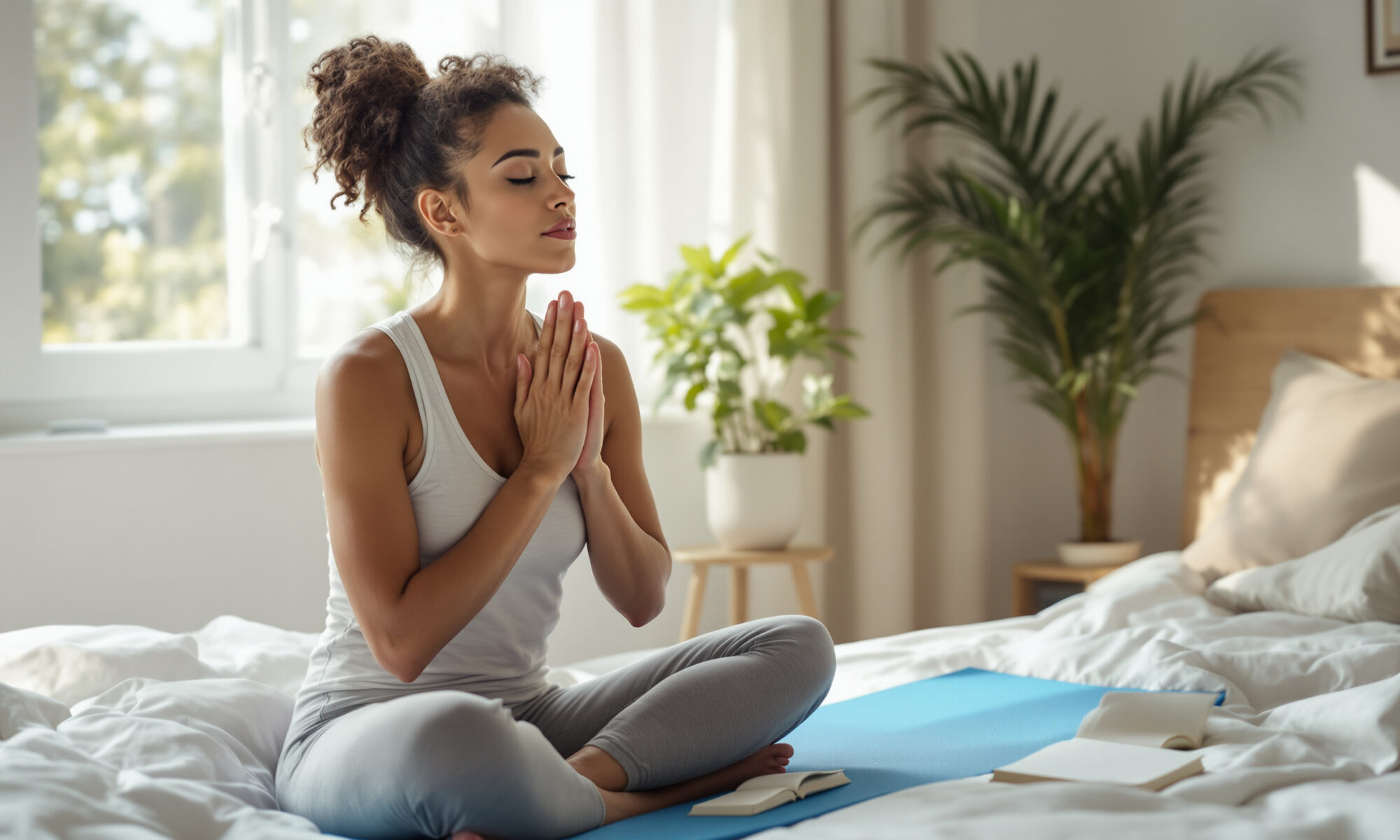
The best-supported mind-body practice for persistent insomnia is cognitive behavioral therapy for insomnia, or CBT-I. Meditation, yoga, and tai chi may improve perceived sleep quality, but their evidence is less certain. Relaxation methods can make bedtime calmer, yet they shouldn’t replace effective insomnia care. Here are eight mind-body practices for sleep, ranked by the strength and relevance of their clinical evidence.
How these sleep practices were ranked
The ranking gives the most weight to randomized trials, systematic reviews, and recommendations from clinical guidelines. It also distinguishes improvement in general sleep quality from treatment of chronic insomnia, a diagnosed disorder involving persistent trouble falling asleep, staying asleep, or getting restorative sleep.
That distinction changes the order. A practice may help people report better sleep without producing clear improvements on actigraphy, which estimates sleep from movement, or polysomnography, the more detailed test used in a sleep laboratory. Subjective relief still matters, but it isn’t the same as objective evidence or proven insomnia remission.
| Rank and practice | Evidence level | Time commitment | Best fit |
|---|---|---|---|
| 1. CBT-I | Strong guideline support; 66 randomized trials in the 2021 AASM review | 4–10 weekly sessions; no fixed daily target | Chronic insomnia |
| 2. Mindfulness meditation | Moderate but mixed evidence | 7–24 minutes daily in digital protocols, commonly for 8 weeks | Bedtime mental arousal |
| 3. Yoga | Limited-to-moderate evidence for sleep quality | No evidence-based universal daily target | People who prefer gentle movement |
| 4. Tai chi | Limited-to-moderate evidence; strongest in older adults | No evidence-based universal daily target | Older adults seeking low-impact movement |
| 5. Progressive muscle relaxation | Small amount of low-quality insomnia evidence | No established universal duration | Physical tension at bedtime |
| 6. Slow breathing | Preliminary; subjective benefits exceed objective findings | At most 10 breaths per minute before bed in reviewed protocols | Short pre-bed relaxation |
| 7. Yoga Nidra | Very-low-certainty evidence | No defensible universal duration | People who like guided body scans |
| 8. Guided imagery | Insufficient or unclear stand-alone evidence | No established universal duration | A calming bedtime routine |
1. CBT-I is the benchmark for chronic insomnia
CBT-I changes thoughts and habits that keep insomnia going. Its core components commonly include cognitive restructuring, stimulus control, sleep restriction or sleep-efficiency work, and sleep education. The aim is to make the bed a cue for sleep again rather than a place for worrying, scrolling, or lying awake.
The evidence is considerably stronger than it is for the other mind-body practices for sleep. The American College of Physicians recommended CBT-I as first-line treatment for adults with chronic insomnia in 2016. In 2021, the American Academy of Sleep Medicine gave multicomponent CBT-I a strong recommendation after an evidence review covering 66 randomized trials.
A 2024 component network meta-analysis included 241 trials and 31,452 participants. Cognitive restructuring, sleep restriction, and stimulus control were associated with higher remission, while the most effective package increased remission by an absolute 0.33 compared with psychoeducation. Put concretely, that difference corresponds to about 33 additional remissions per 100 treated people, although network comparisons can’t predict any one person’s result.
Courses usually involve 4 to 10 weekly sessions. The 2025 VA/DoD guideline recognizes individual, group, telephone, guided self-help, and digital formats, so access doesn’t always require weekly office visits. A trained clinician or validated digital CBT-I program is the sensible starting point because sleep-restriction work can temporarily increase tiredness and needs tailoring around safety-sensitive work, bipolar disorder, seizure disorders, and other health concerns.
2–4. Meditation, yoga, and tai chi
Mindfulness meditation trains present-focused, nonjudgmental attention. It may reduce the mental and emotional arousal that makes a tired person remain stubbornly awake. Digital research protocols have used 7 to 24 minutes per day, commonly for eight weeks, though those study schedules aren’t a guaranteed prescription.
A 2026 network meta-analysis of 45 studies and 3,568 older adults found that meditation, yoga, and tai chi each improved subjective sleep quality compared with control conditions. Meditation had the highest probability of ranking best in that population. The age group and subjective outcome matter: the result doesn’t prove that meditation treats chronic insomnia in all adults.
If racing thoughts are part of your sleep problem, try a short guided mindfulness practice at the same time each evening and assess the pattern over several weeks. Our guide to using mindfulness for mental health explains the basic skill without treating it as a cure-all.
Yoga combines posture, breathing, and attention. A 2020 review summarized by the National Center for Complementary and Integrative Health covered 19 studies and 1,832 women and suggested better sleep quality. Reviews through 2022 remained encouraging, but they didn’t establish yoga as a treatment for insomnia, and class styles, frequency, and duration varied too widely to support one daily target.
Tai chi uses slow sequences, controlled breathing, and focused attention. A 2022 review summarized by NCCIH included five studies and 742 participants, with possible sleep-quality benefits particularly among older adults. Evidence for insomnia itself was insufficient. For either movement practice, a qualified instructor can modify balance demands, painful positions, pregnancy-related limitations, or mobility restrictions.
5–6. Try muscle relaxation or slow breathing
Progressive muscle relaxation involves deliberately tensing and releasing muscle groups in sequence. It gives your attention a concrete task while making physical tension easier to recognize. NCCIH describes the stand-alone insomnia evidence as a small body of low-quality research, although relaxation may also appear within a broader CBT-I program.
An audio-guided session is a practical way to learn the sequence. Keep the contractions comfortable, and skip an injured or painful area. Among the simpler mind-body practices for sleep, this one is low-cost and easy to repeat, but honestly, its stand-alone evidence is much thinner than CBT-I’s.
Slow breathing has a plausible calming effect, but objective sleep results remain unsettled. A 2026 systematic review of nine studies involving 457 participants found improvements in self-reported sleep duration or quality after bedtime slow breathing. Actigraphy and polysomnography findings were inconclusive, so the review supports perceived benefit more clearly than measurable changes in sleep.
Protocols used no more than 10 breaths per minute, and studies lasting 28 to 30 days produced the reported subjective findings. Start gently rather than taking forceful, oversized breaths, which can make you lightheaded. For practical patterns and cautions, see these breathing techniques for stress relief.
7–8. Yoga Nidra and guided imagery need better evidence
Yoga Nidra is usually an audio-guided body scan or deep-relaxation practice performed while lying down. A 2026 meta-analysis found just five unique studies. Only two randomized trials, totaling 99 participants, measured insomnia severity; their pooled result wasn’t statistically significant, and the certainty of evidence was rated very low.
There isn’t enough consistent research to name a defensible daily duration. You can use Yoga Nidra as a calming routine if you enjoy it, but claims that it replaces several hours of sleep aren’t supported by the evidence provided here.
Guided imagery directs attention toward a calming scene, often through an audio recording. It’s accessible and may help shift attention away from bedtime worry, but its stand-alone insomnia evidence is insufficient or unclear. Treat it as a relaxation aid, not as the equivalent of CBT-I.
These weaker rankings don’t mean nobody benefits. They mean researchers can’t yet separate specific effects from expectation, quiet rest, attention from an instructor, or ordinary night-to-night changes. That nuance is often lost when complementary approaches are discussed as a single category; a broader review of the benefits and limits of alternative medicine can help you judge similar claims.
Choose a practice and know when to seek care
Match the method to the problem. Persistent insomnia calls for CBT-I, while occasional tension or bedtime rumination may justify trying meditation, muscle relaxation, or slow breathing. Yoga and tai chi may suit you if you want gentle movement plus attentional practice, especially in later life.
- Define the main issue: persistent insomnia, racing thoughts, muscle tension, or a wish for better general sleep quality.
- Choose one practice whose evidence and physical demands fit that issue.
- Use it consistently for the studied period when one is known, rather than changing methods every night.
- Track bedtime, estimated sleep onset, awakenings, wake time, and daytime function in a simple diary.
- Review whether you function better, not merely whether a wearable reports more sleep.
Consumer trackers can be useful for patterns, but they don’t diagnose insomnia or sleep apnea. Read our explanation of how accurately sleep trackers measure sleep before treating a nightly score as a medical result.
Arrange a medical assessment if sleep trouble persists, significantly affects daytime life, or comes with loud snoring, gasping, breathing pauses, or marked sleepiness. The National Heart, Lung, and Blood Institute states that clinicians may use a sleep study during insomnia assessment to look for another disorder, including sleep apnea; it doesn’t mean everyone with insomnia needs one. Discuss symptoms, pregnancy, chronic illness, mental health concerns, and medications with a qualified clinician rather than replacing prescribed care with a relaxation practice.
Frequently asked questions
What is the most effective mind-body practice for insomnia?
Multicomponent CBT-I has the strongest evidence and is recommended as first-line treatment for chronic insomnia by major US clinical guidelines. Meditation and relaxation can be useful additions, but they don’t have equivalent support.
How long do mind-body practices for sleep take to work?
It depends on the method. CBT-I commonly lasts 4 to 10 weekly sessions, mindfulness protocols often run for eight weeks, and slow-breathing studies reporting subjective benefits lasted 28 to 30 days.
Can meditation replace CBT-I?
Current evidence doesn’t support treating meditation as a substitute for CBT-I in chronic insomnia. It may be reasonable for bedtime arousal or general sleep quality, either alone for mild occasional problems or alongside evidence-based care.
Can yoga cure insomnia?
No cure claim is supported. Reviews suggest yoga may improve subjective sleep quality, but study methods vary and the evidence doesn’t establish yoga as an insomnia treatment.
Should I trust my sleep tracker when testing a practice?
Use the device to observe broad patterns, not to diagnose a disorder or judge a single night. Pair its data with a sleep diary and how alert and functional you feel during the day.